AI & Science
AI won't replace scientists. It will make the current model of science obsolete

The debate about AI and science is stuck in the wrong place. Every conference panel, every LinkedIn post, every article asks some version of the same question: will AI replace scientists?
That is not the interesting question.
The interesting question is whether AI will expose something we have been quietly ignoring for decades: that the way we currently discover and develop new materials, new catalysts, new industrial processes is so slow, so expensive, and so biased that it has been holding back human progress in ways most people don't yet understand.
I think it will. And I think that's not a threat. It's the most important shift in science in a generation.
Let me tell you what actually happens in a materials science lab.
You have an idea. Maybe you read something exciting about metal-organic frameworks, or you want to test a new catalyst composition for CO2 conversion. So you start making it.
Here's the part that doesn't make it into the journal articles: about 80% of your time as a scientist is not spent discovering new things. It's spent trying to understand what you already made. Because in materials science, what you mix is not always what you think you're making. A small change in temperature. A shift in humidity. A slightly different pressure in the reactor. These things change how a material looks, how it behaves, sometimes completely.
So you make the material. Then you spend weeks characterizing it. Then you put it in a reactor to test what it actually does. And it changes again. Shape, chemistry, structure. Sometimes five or six times before you get a stable result.
And that's if your experiment is reproducible in the first place. The average reproducibility rate of experimental data in materials science is around 40%. Which means that more than half of the scientific data we've published, the data we've been using to train AI models, cannot be reliably recreated by someone else in a different lab. ("87% of chemists failed to reproduce at least one experiment". Baker, M. (2016). 1,500 scientists lift the lid on reproducibility. Nature, 533, 452–454)
We've been building on quicksand and calling it a foundation!

Here's the number that stopped me when I first started thinking seriously about this: since 1950, there have been roughly 12 to 18 genuine industrial breakthroughs in materials chemistry. (based on analysis of ICIS industrial chemical process innovations, 1950–2024). In over 70 years. The most recent one, a process called HPPO for making propylene oxide that cut CapEx by 25% and reduced wastewater by more than 80%, happened in 2008. ("The HPPO process reduces wastewater by 70–80%, energy use by 35%, and capital cost by 25%". US EPA Presidential Green Chemistry Challenge, 2010.)
That was 17 years ago.
We are not slow because scientists are not smart. We are slow because the system that generates new knowledge is optimized for the wrong things. Academic research rewards publication, not translation. Industry rewards incremental improvements, not breakthroughs. And the data that both systems produce is inconsistent, unreproducible, and measured under conditions that often have little to do with how materials actually behave at an industrial scale.
This is the gap. Not the intelligence gap. The data gap!
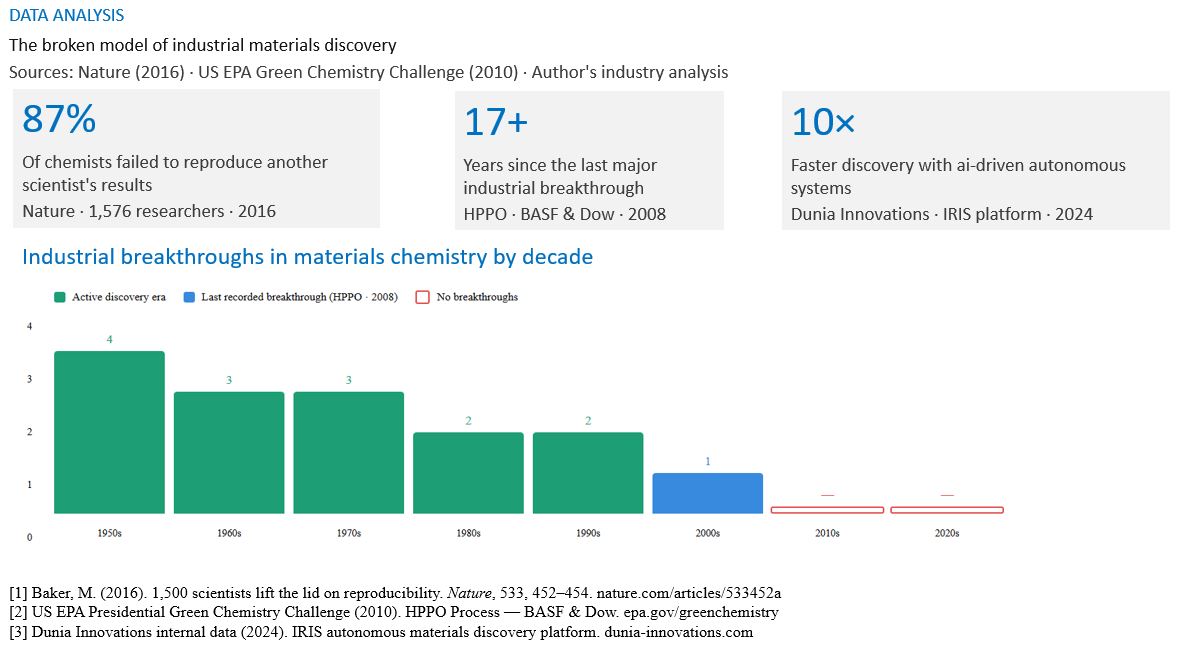
When I started building Dunia with my co-founders, we thought a lot about what was actually blocking progress. And we kept coming back to the same realization: the bottleneck was not the AI model. The bottleneck was the data you would need to train it properly.
You cannot build a reliable AI for materials discovery on top of data that is 40% reproducible. You cannot train a system to find new catalysts using information collected under lab conditions that bear no resemblance to how a refinery or a chemical plant actually operates. And you cannot bridge the gap between "this looks interesting on a computer" and "this works at scale" by running more simulations.
So we did something different. We decided to solve the data problem first.
We built IRIS, an autonomous platform that can predict, design, make, test, and characterize hundreds of materials per day, under industrially relevant conditions. Not in a vial on a benchtop. Under the pressures, temperatures, and chemical environments that an actual industrial process would demand.
When partners come to our facility in Berlin and see IRIS running, there is usually a moment of quiet. Not because it is flashy. Because they realise it doesn't exist anywhere else. And they immediately understand what that means.

So back to the original question. Will AI replace scientists?
No. But here is what I believe will happen, and I think it will happen faster than most people in our field are ready for.
The scientists who learn to work alongside autonomous systems, who stop spending 80% of their time characterizing what they already made and start using that time to ask better questions, will be able to do in a year what previously took a decade.
The scientists who don't will find that the system they trained for, the system of careful forward design, one experiment at a time, is simply too slow to be competitive.
This is not about job replacement. It is about a fundamental shift in what it means to do science. The serendipity that gave us so many of our greatest discoveries, the lucky observation that leads somewhere unexpected, that doesn't go away. But instead of waiting years for it, you start engineering the conditions for serendipity to happen more often.
That is what accelerated discovery actually means. Not AI that replaces the scientist. AI that makes the search space so much larger, and the feedback loop so much faster, that breakthroughs stop being rare events and start being something you can actually plan for.
We are at the very beginning of understanding how matter, energy, and living systems interact. The knowledge we have accumulated across all of human history is a footnote compared to what remains undiscovered.
That is not a reason for humility. It is the greatest argument for urgency.
