Energy & Climate
Short Takes
News
Europe Doesn't Have a Capital Problem. It Has a Buyer Problem

This expanded essay was originally published in the FII Institute THINK essay series at the FII Priority Summit, Rome, June 17–19, 2026. Read the full collection here →
When you raise capital for a deep-tech venture in Europe, the first question from a European investor is almost never "how big is the vision?" or "how do we capture the market?" It is almost without exception: "do you have commercial traction?"
That question is usually asked last in Silicon Valley, if it is asked at all. Tesla was founded in 2003 and didn't show meaningful market traction until the Model S launched in 2012. Very few European VCs would have backed that nine-year journey on the question of traction alone.
This is not because European investors are less ambitious. It is because they are responding rationally to a structural condition the current prevailing narrative still misses: Europe doesn't have a capital problem. It has a buyer and market adoption problem.
The capital position of European deep-tech
In 2025, European deep-tech startups raised approximately $20.3 billion — nearly one-third of all European venture capital.¹ Paris-based Mistral AI closed a €1.7 billion Series C led by ASML at an €11.7 billion valuation.² Munich-based Helsing raised €600 million at a €12 billion valuation.³ London-based Wayve raised over $1 billion.⁴ French unicorns have soared from seven in 2015 to 42 in 2024, and Europe's share of global deep-tech unicorns has doubled from 4% in 2021 to 8% in 2024.⁵
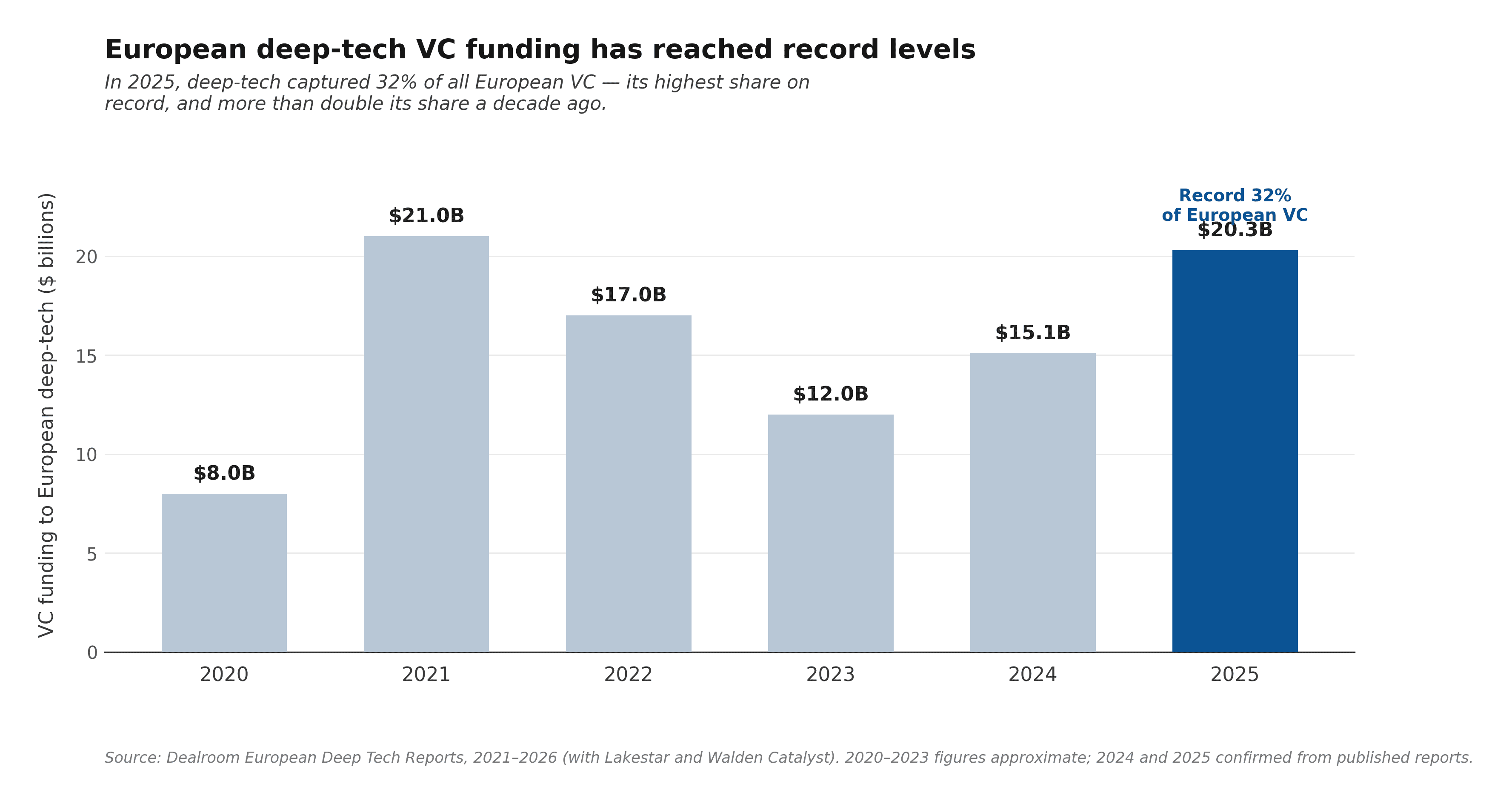
The scale of funding is still smaller than in the United States, but the capital in Europe is sufficient. The high-quality talent is here too. What is missing is the bridge between them and revenue.
The first-buyer constraint
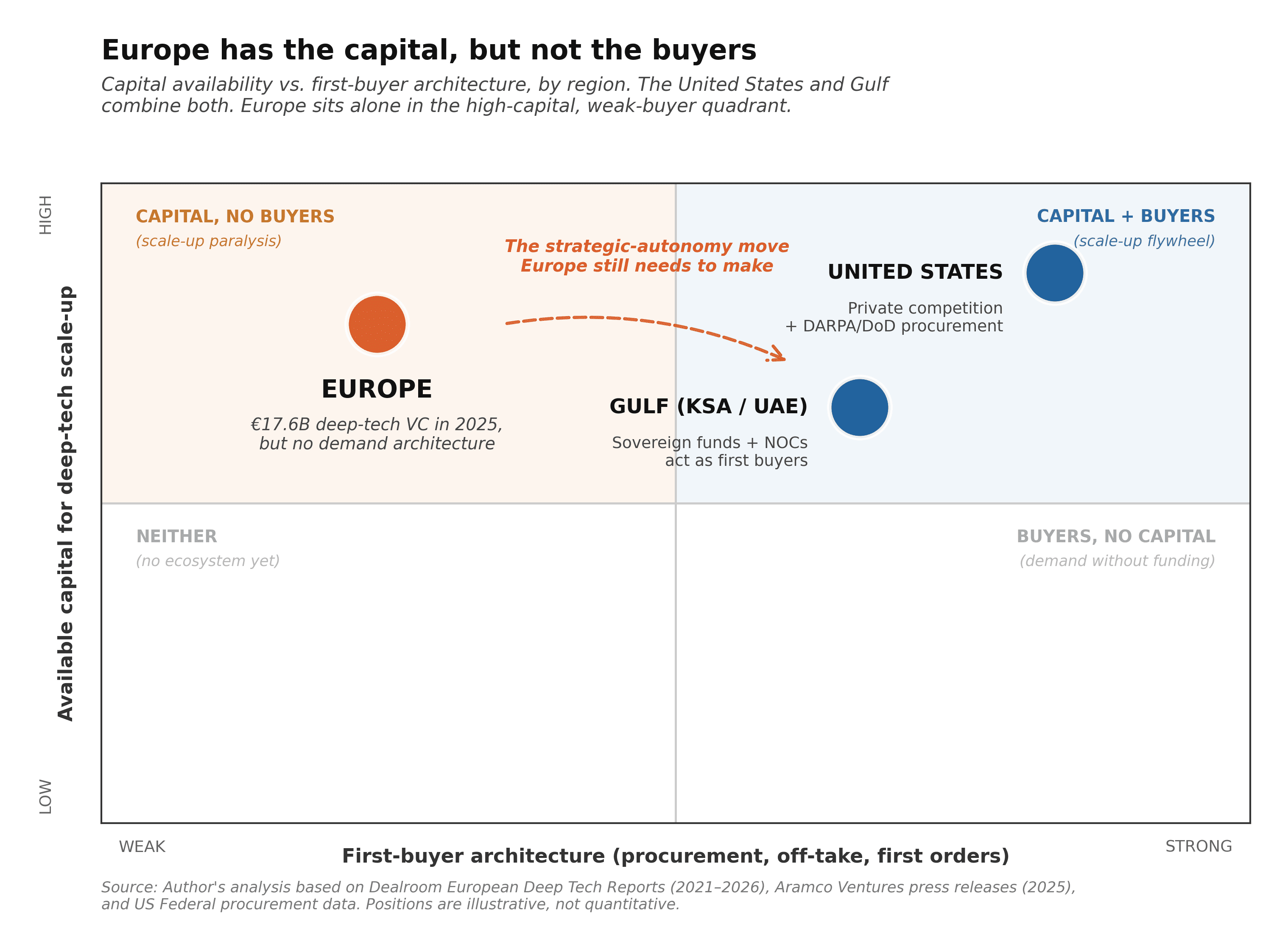
European deep-tech founders live inside what I call a circular dependency. Smart capital waits for first industrial buyers before backing scale-up rounds. First industrial buyers wait for the technology to be de-risked at commercial scale before placing orders. Each side is acting rationally. Together, they are paralysing European technological scale-up.
This dynamic exists with much less intensity in the United States, where industrial competition is fiercer than collaboration. If a US incumbent does not adopt a novel technology, their closest competitor will — and then overtake them. The prevailing R&D culture in Europe is collaboration, which inadvertently removes the urgency for incumbents to take early bets on scale-up companies. The result is a continent that funds world-class research, builds globally competitive labs, and then watches its scale-ups stall, get acquired abroad, or relocate to where buyers move first.
I have witnessed this pattern firsthand over the last six years building at Dunia Innovations and Aquature. The conversations with industrial players are almost always positive. The intent to collaborate is genuine. But when it comes to placing a first-of-a-kind order, signing the contract that de-risks the technology commercially, the hesitation is structural, not personal. Boards don't reward executives for being first. They reward them for being right. And without a system that insulates first buyers from that risk, rational people make a collectively irrational choice.

Two forces now disrupting the equilibrium
The first is geopolitical. The post-2022 environment has shaken Europe's sense of strategic security, and not entirely in a bad way. There is now a top-level commitment to building European capacity in defence, AI, semiconductors, aerospace, and clean industrial technology. For the first time in decades, European deep-tech rounds rival Silicon Valley headlines, and Gulf capital is opening offices to participate.
Aramco Ventures will open a Paris office in 2026, with over $7 billion in allocated capital and hundreds of millions earmarked for European deep-tech.⁶ Its first French bets include Pasqal, the Paris-based quantum company that in 2024 signed an agreement to install Aramco's first quantum computer in Saudi Arabia, recently inaugurated in Dhahran.⁷ A European scale-up and a Gulf first buyer. This is what industrial demand architecture looks like in practice.
The second is industrial pressure. Europe's chemical, energy, and materials majors are being squeezed by disrupted supply chains, high energy costs, and regulatory complexity. BASF is cutting €2.3 billion in annual fixed costs by 2026, closing plants and reducing its Antwerp workforce by 16%.⁸ This perfect storm is forcing European incumbents to do what they have historically resisted: take real risks with scale-up companies to share market exposure and accelerate local technology development.
What Europe still needs to build
The strategic-autonomy lever Europe is missing is not another funding round (though Europe needs those too). Europe need a modern industrial demand architecture: public procurement guarantees for first-of-a-kind technologies, government-backed off-take agreements, and project insurance that allows European industrial leaders to act as first buyers without their boards treating it as a career-ending bet.
The Gulf does this instinctively. The United States does it through both private competition and government procurement. Europe must learn to do it more deliberately.
The capital is here, and the science is here. The geopolitical will is finally here. What is needed now is the demand-side commitment that converts scale-up pilots into European industrial champions. Building that architecture is the most consequential industrial policy decision of the decade, and the one with the highest return if executed successfully and with urgency.
References
Dealroom European Deep Tech Report 2026 (with Lakestar and Walden Catalyst). 2020–2023 figures approximate; 2024 and 2025 confirmed from published reports.
Mistral AI Series C announcement, September 2025.
Helsing Series D announcement, June 2025; Sifted, Defence unicorn Helsing raises €600m (June 2025).
Wayve Series C, May 2024, led by SoftBank.
McKinsey & Company, Europe's Deep-Tech Engine Could Spur $1 Trillion in Economic Growth (October 2025).
Aramco Ventures press release, Aramco Ventures to Open New Office in Paris (November 2025).
Aramco, Wa'ed Ventures: A Decade of Empowering Entrepreneurs (March 2025).
BASF 2025 financial results; BASF Antwerp restructuring announcement (October 2025).